
Boat Basics: Parts of a Boat
If you’re new to boating, you’ve probably discovered that boating has its own language. Words you’ve known all your life no longer apply when you’re on a boat. From the simple – there is no front and back or left and right on a boat – to the more complex – what exactly is a gunwale – you’ll need an entirely new vocabulary to join the boating world.
Why does everything have a different name?
Learning new terms for the parts of a boat and even directions can be confusing to new boaters. Why do you need to use starboard and port anyway, and why is the steering wheel called the helm?
When it comes to directions on a boat, the answer is one of necessity. Sailors needed a set of words for directions that didn’t depend on which direction a sailor is facing. When working together to move or dock a ship, sailors needed a common language thus the stern, bow, starboard, and port nomenclature came to be.
As for the other words used to identify parts of a boat, most of them are steeped in naval tradition. For example, the word helm refers to the part of the ship used to steer, including the wheel or other steering mechanisms. The word comes from the Old English word helme, which roughly meant “rudder” or “instrument used to steer the ship.”
Directions
The first thing new boaters should learn is the different names for directions on a boat or a ship. Instead of front, back, left, and right, sailors use bow, stern, port, and starboard.
Bow: The bow is the front of the boat.
Stern: The stern is the back of the boat.
Port: Port refers to the left side of the boat when you’re facing the front of the boat. Initially, sailors called the left side of the boat larbord (the loading side) because that was most often the side that was tied up to the dock, but it was too close to the word starboard. Sailors then switched to using the word port because that was the side of the boat that most often faced the port when the ship was tied up.
Starboard: Starboard refers to the right side of the boat when you’re facing the front of the boat. The term starboard comes from two Old English words that meant steer (stéor) and side of the boat (bord). Before rudders, sailors would use a steering oar that was most often put through a hole on the right side of the boat, leading sailors to call that side of the boat starboard.
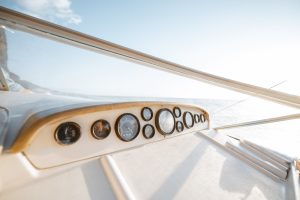 White yacht dashboard outdoors, close-up view
Parts of the Boat
It’s not just enough to know nautical terms for directions, you also need to familiarize yourself with the names for the different parts of your boat. Using the correct terms is helpful because it gives boaters and sailors a common language to describe experiences and problems.
Let’s dive into a few of the most important terms to know.
Deck: The deck of a boat is the part that covers the hull. It’s essentially the floor of the boat that you walk on. While this may seem like an obvious piece of the boat, it’s necessary to understand that the deck performs an important structural function in addition to providing a place to walk.
Hull: The hull is the body of the boat, and hulls come in a variety of shapes that are suited to different purposes. Understanding the hull shape of your boat will help you know what your boat is capable of doing.
- V-shaped hull: Most power boats have a V-shaped or planing hull, which allows them to quickly power over the water.
- Pontoon hull: As its name implies, this is the type of hull you’ll find on a pontoon boat. It has pontoons on each side that keep the boat afloat.
- Displacement hull: Large ships have displacement hulls that allow them to keep the massive weight of the boat afloat by displacing the water below.
- Flat-bottomed hull: Fishing boats and other boats built for stability have flat-bottomed hulls that minimize rolling.
- Round-bottomed hulls: Canoes and kayaks often have round-bottomed hulls. These hulls cut quickly through the water but lack stability.
Keel: The keel is an important part of the hull, acting as a sort of backbone for the boat. It is the lowest part of the hull that runs the entire length of the boat, providing strength and stability to the hull.
Bilge: The lowest part of the interior of the boat is called the bilge. This is where water from leaks, waves, and condensation will collect and will need to be emptied with a bilge pump system.
Gunwales: No, this isn’t a term leftover from whaling ships. Gunwales, pronounced gunnels, are the stiff, upper edges of the hull. They provide extra stability and rigidity to the hull to keep it from warping or being damaged by waves, wind, or debris. They can be made from a variety of materials, including metal, wood, or composites. If you’re going to attach a cupholder or fishing rod to your boat, most often, you’ll attach it to the gunwale.
Helm: The helm is the navigation controls of the boat, whether that’s a wheel, an electronic panel, a tiller, or a joystick.
Transom: The transom is a flat or slightly curved area at the stern of the boat. Structurally, it holds the two sides of the hull together and provides a solid mounting point for an outboard motor.
Cleat: Cleats are often mounted on the gunnel or deck and are used for tying up the boat at the dock. You can choose from a variety of different types of cleats:
- Standard cleats: These cleats are the most common. These surface-mounted cleats are inexpensive and can be mounted without access to the back side of the mounting surface.
- Pull-up cleats: These cleats work exactly like their name states: You pull them up to use them. When not in use, they sit inside a surface-mounted housing connected to your deck or gunwale.
- Pop-up cleats: Like their name says, these cleats pop up out of a recessed metal plate at the touch of a button. They are essentially pull-up cleats powered by a spring.
- Flush-mount cleats: Unlike standard pull-up and pop-up cleats, flush-mount cleats are recessed into the mounting area, so when not in use, they sit at the same level as the mounting surface. This helps to avoid people tripping over them or catching fishing lines in them. They come in both pop-up and pull-up versions.
- Folding cleats: Like pull-up and pop-up cleats, folding cleats stay out of the way until you need them, but unlike the other two types of cleats, folding cleats use a hinge mechanism, causing them to “fold” into the plate attached to the boat. Often, these cleats have a button that when pressed causes the cleat to rise.
While there are many more naval terms for things on a boat like cabin (a bedroom), pilot house (the place that holds the helm), galley (the kitchen), and head (the bathroom), getting started with a basic understanding of the most important parts of your boat and the naval terms for directions will let you accurately communicate with other boaters and any maintenance professionals. Now, it’s time to get out on the water!
